
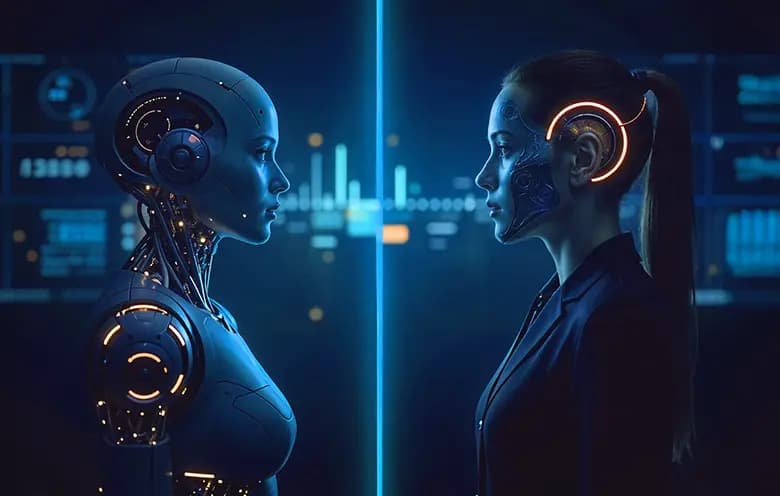
AI Agents vs. AI Assistants: Understanding the Next Evolution in Enterprise Intelligence
AI agents go beyond executing tasks—they predict, decide, and transform entire operations. As artificial intelligence adoption accelerates, businesses must recognize how AI agents differ from AI assistants and assess the strategic implications of these advanced systems.
Executives face a pivotal question: should AI simply support decision-making, or evolve into a system that autonomously drives it?
Table of Contents:
- AI Assistants Execute—AI Agents Decide
- Trust and Control—Who Governs AI Agents?
- Business Impact—Efficiency vs. Industry Disruption
- Security and Compliance—The Unsolved Challenge
1. AI Assistants Execute—AI Agents Decide
AI assistants like Siri, Google Assistant, and enterprise chatbots respond to direct input and streamline routine operations. They are reactive, requiring human instruction to function effectively.
By contrast, AI agents operate autonomously. They analyze vast datasets, generate predictive insights, and make independent decisions. From optimizing supply chains to detecting cyber threats in real time, AI agents proactively manage complex systems. Market forecasts suggest AI agents will grow by 300% by 2025, driven by adoption in finance, healthcare, and logistics.
For executives, the challenge lies in deploying AI agents in ways that deliver value while minimizing operational risk and unpredictability.
2. Trust and Control—Who Governs AI Agents?
AI agent autonomy introduces new ethical and legal concerns. Their continuous learning and evolving nature make it difficult to guarantee compliance or fairness.
Global regulatory efforts like the EU AI Act and the U.S. AI Bill of Rights aim to provide oversight, but significant gaps remain. Recent incidents—such as financial firms suffering AI-led trading losses and bias allegations in AI recruitment—highlight the urgent need for enforceable governance frameworks.
Balancing independence with oversight will be key in managing AI agents responsibly.
3. Business Impact—Efficiency vs. Industry Disruption
While AI assistants improve productivity, AI agents are industry disruptors. Their capabilities are already reshaping critical sectors:
- Finance: AI agents manage portfolios autonomously, replacing traditional advisory roles.
- Healthcare: AI agents aid diagnostics and create personalized treatment plans.
- Cybersecurity: Agents detect and neutralize threats in real time.
According to McKinsey, AI-powered automation will generate over $3.5 trillion in economic value by 2027. The shift to AI agents isn’t optional—it’s a strategic necessity for long-term competitiveness.
4. Security and Compliance—The Unsolved Challenge
AI agents must operate in unpredictable environments, making decisions that might exceed predefined ethical or legal boundaries. Gartner predicts that cyberattacks on AI systems will rise by 400% by 2026, exposing organizations to new vulnerabilities.
To mitigate risk, companies must build robust governance systems:
- Transparent AI: Ensure decisions are explainable and auditable.
- AI Ethics Boards: Establish internal teams to oversee AI behavior.
- Adaptive Compliance: Continuously update AI models to reflect evolving regulations.
Without these safeguards, the risks of adopting AI agents could outweigh the benefits.
The Strategic Decision—Lead the AI Shift or Struggle to Catch Up?
Forward-thinking leaders are moving beyond pilots. Some adopt a hybrid model—using AI agents in select workflows while keeping humans involved in critical decisions. For example, logistics firms use AI for real-time supply chain optimization but rely on human judgment for rerouting. Financial institutions use AI to detect fraud but require human approval for major transactions.
AI agents are no longer tools—they are partners and disruptors. Enterprises that align AI agents with business goals, comply with evolving laws, and strike the right balance between automation and human oversight will lead the future of industry.
Discover more cutting-edge insights on AI, IoT, cybersecurity, and tech innovation at ITech360hub.