
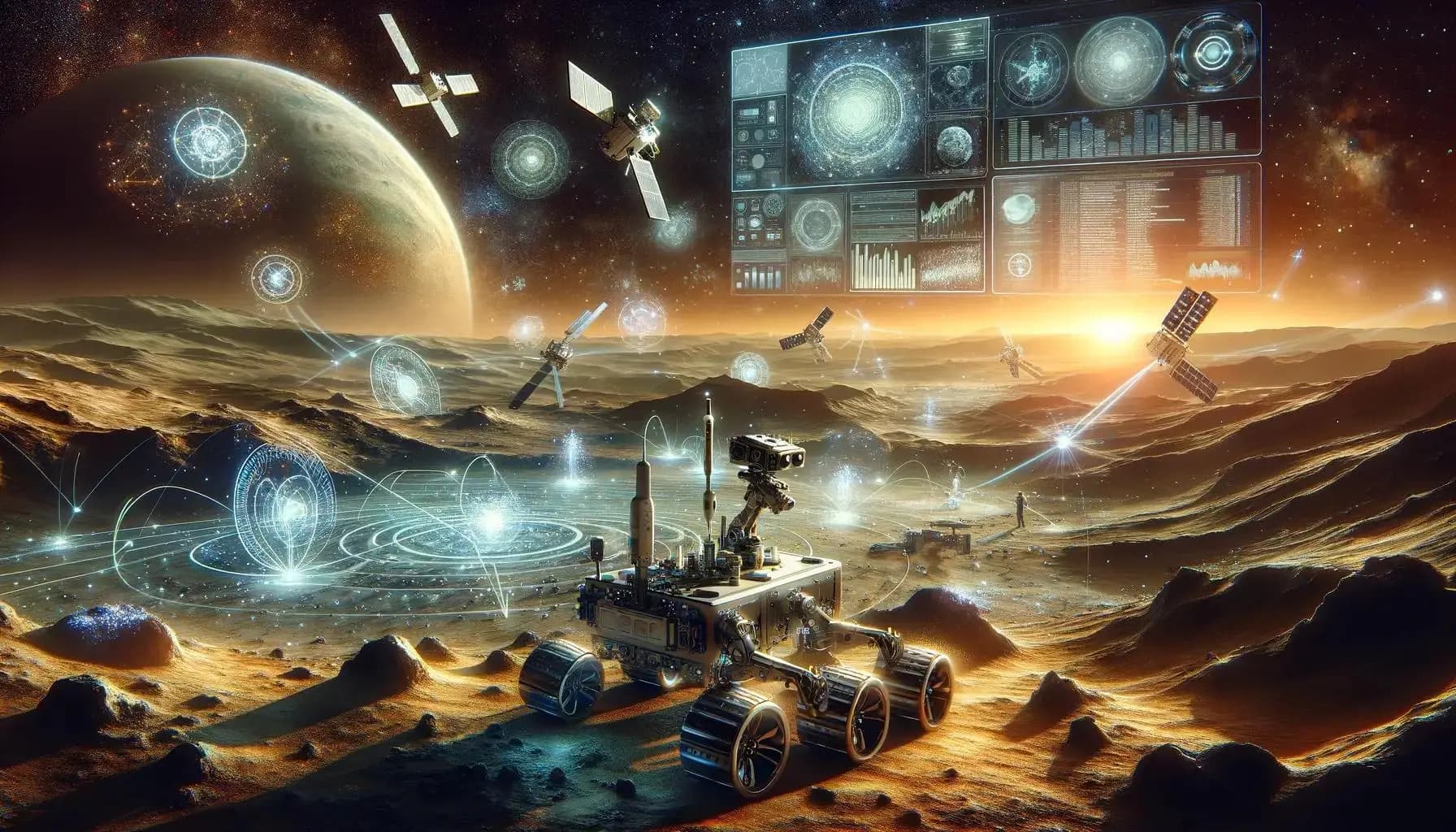
AI and Robotics in Space: The Next Epoch of Exploration
AI and robotics are fundamentally transforming space exploration. As intelligent systems evolve from following commands to making independent decisions, a new question emerges—will humans remain the leaders of space discovery, or simply become participants?
In 2025, organizations like NASA and private aerospace companies will invest over $10 billion into AI-driven space technologies, aiming to launch an era where machines explore, build, and operate autonomously beyond Earth.
Table of Contents:
- Machines That Think, Not Just Execute
- Robots Are Building the Future—Literally
- Mining in Space—Trillion-Dollar Industry or Mirage?
- Quantum AI: The Next Leap in Intelligence
- The Space Race Is Now an AI Race
1. Machines That Think, Not Just Execute
AI has already proven effective in rovers like Perseverance, but the future of deep space missions requires more than simple autonomy. These systems must detect failures, reroute missions, and make judgment calls without human direction.
The shift to AI-led missions hinges on our ability to develop models capable of making real-time, life-critical decisions in unpredictable environments.
2. Robots Are Building the Future—Literally
The vision of constructing lunar and Martian bases is rapidly becoming a reality. AI-driven robots equipped with autonomous 3D printing and material sourcing tech will soon build space infrastructure without human intervention.
NASA’s goal to deploy autonomous builders by 2028 underlines the importance of AI in resource management, energy efficiency, and self-sustaining development—reducing dependency on Earth-bound supplies.
3. Mining in Space—Trillion-Dollar Industry or Mirage?
Asteroids such as 16 Psyche contain vast reserves of precious metals worth more than $10 quintillion. AI-controlled mining robots could revolutionize the global supply chain for rare elements.
Yet, ownership of extraterrestrial resources remains murky. Without a unified legal framework, disputes between nations and corporations could delay the commercialization of space mining.
4. Quantum AI: The Next Leap in Intelligence
Combining quantum AI with edge computing will enable spacecraft to process data in real time—even in low-latency, low-bandwidth environments. By 2025, quantum-enabled AI is projected to reduce mission failure rates by up to 40%.
This evolution sparks a major ethical and governance question: as machines optimize themselves, can humans continue to guide and regulate their behavior effectively?
5. The Space Race Is Now an AI Race
The battle for AI supremacy in space pits government agencies against tech-driven private firms like SpaceX, Blue Origin, and emerging Chinese startups.
With AI-powered satellites already being deployed for defense, communication, and surveillance, outer space is becoming a geopolitical and commercial frontier driven by algorithmic intelligence.
Final Thought: Who Really Controls the Future?
As we enter a space era dominated by autonomous systems, the role of humans shifts from command to collaboration. Leadership will go to those who understand AI not merely as a tool—but as a co-pilot in discovery.
The key question remains: will we program AI to serve human intentions, or are we stepping into a future where machines evolve beyond our control?
Explore ITech360hub for the latest advancements in AI, IoT, Cybersecurity, AI Tech News, and expert insights shaping the future of innovation.