
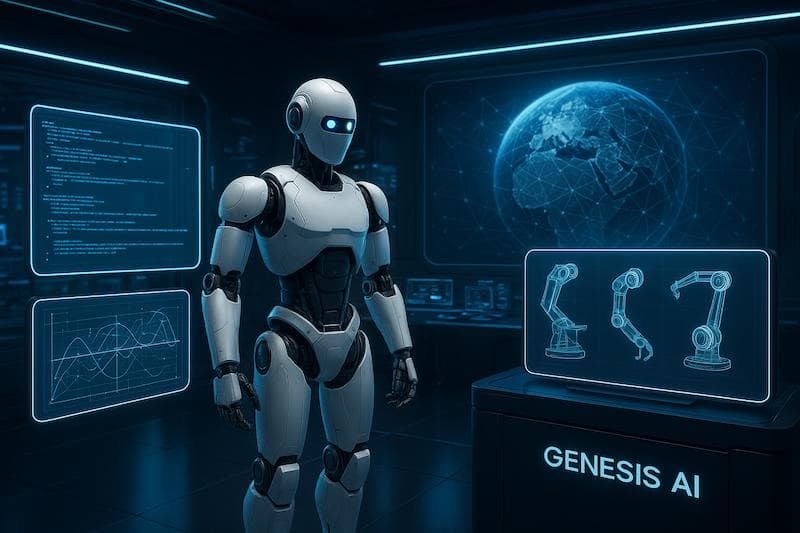
Genesis AI, a global physical AI research lab and full-stack robotics company, has emerged from stealth with a mission to unlock unlimited physical labor. The company is developing a universal Robotics Foundation Model (RFM) and a horizontal robotics platform, backed by $105 million in funding co-led by Eclipse and Khosla Ventures, with participation from Bpifrance, HSG, and notable investors Eric Schmidt and Xavier Niel.
Physical labor, estimated at $30–40 trillion of the global GDP, remains over 95% unautomated due to the limitations of current robotic systems. Traditional industrial robotics rely on brittle, narrow, and expensive-to-deploy software stacks. Genesis aims to revolutionize general-purpose robotics with enhanced robustness, flexibility, and cost efficiency, ultimately automating all forms of physical labor.
A Data-Centric Full-Stack Approach to Physical AI
Genesis is building a scalable, universal data engine combining high-fidelity physics simulation, multimodal generative modeling, and large-scale real robot data collection. Its proprietary simulation stack will produce high-quality synthetic data at scale, complemented by a robust real-world data collection system. By unifying these historically separate domains, Genesis will create one of the largest and most diverse datasets for training RFMs.
“General-purpose robots powered by physical AI will define the next major chapter of human history,” said Zhou Xian, CEO of Genesis. “While digital AI has made extraordinary progress, physical AI — the intelligence that enables machines to perceive, understand, and interact with the real world — has lagged behind. We’re here to change that by combining digital AI knowledge with real-world robotics, unlocking unmatched scalability, capability, and efficiency to meet global labor demands.”
Industry Expertise and Open Innovation
Founded by experts from Mistral AI, Nvidia, Google, CMU, MIT, Stanford, Columbia, and UMD, Genesis has deep technical expertise in physics simulation, graphics, robotics, and large-scale AI model training. The company plans to open-source parts of its data engine and foundation model to enable developers, researchers, and partners to accelerate advancements in physical AI.
Investor Perspectives
“Even in the most automated industries, the robot-to-human ratio rarely exceeds 1:30 due to tasks requiring dexterity, cognition, and real-world reasoning,” said Charly Mwangi, Partner at Eclipse. “General-purpose robotics can transform trillions in labor value across industries, and Genesis is positioned to lead this era.”
Kanu Gulati of Khosla Ventures added: “Physical AI has yet to scale like LLMs because real-world data collection is operationally complex. Genesis’s integration of high-quality simulation data with real robotics data in a closed-loop system provides a unique competitive advantage.”
For more on AI, IoT, cybersecurity, and emerging tech insights, visit ITech360hub.