
KAYTUS Upgrades KSManage With Full-Stack O&M Visibility for AI Data Centres — Predicting Hardware Failures Seven Days in Advance
AI / Machine Learning | 4 min read
KAYTUS (Singapore; a leading provider of end-to-end AI server and liquid cooling solutions for cloud, AI, edge computing, and emerging applications), has significantly upgraded KSManage — its AI data centre management platform — introducing full-stack, four-level visibility across components, servers and cabinets, clusters, and AI jobs. The enhanced platform addresses four critical operational challenges that constrain efficiency in AI data centres at scale: complex troubleshooting across heterogeneous infrastructure, higher component failure rates driven by high-power-density devices, intricate AI application dependencies, and delayed responses to operations and maintenance (O&M) incidents. A single outage in an AI data centre can result in losses exceeding USD $1 million — underscoring the growing importance of availability and resilience as AI infrastructure becomes mission-critical. KSManage is now designed specifically for the next generation of AI data centre operations, with a four-layer intelligent monitoring framework that enables automated fault detection, early warning, and intelligent remediation.
Four-Layer Intelligent Monitoring — From Components to AI Jobs
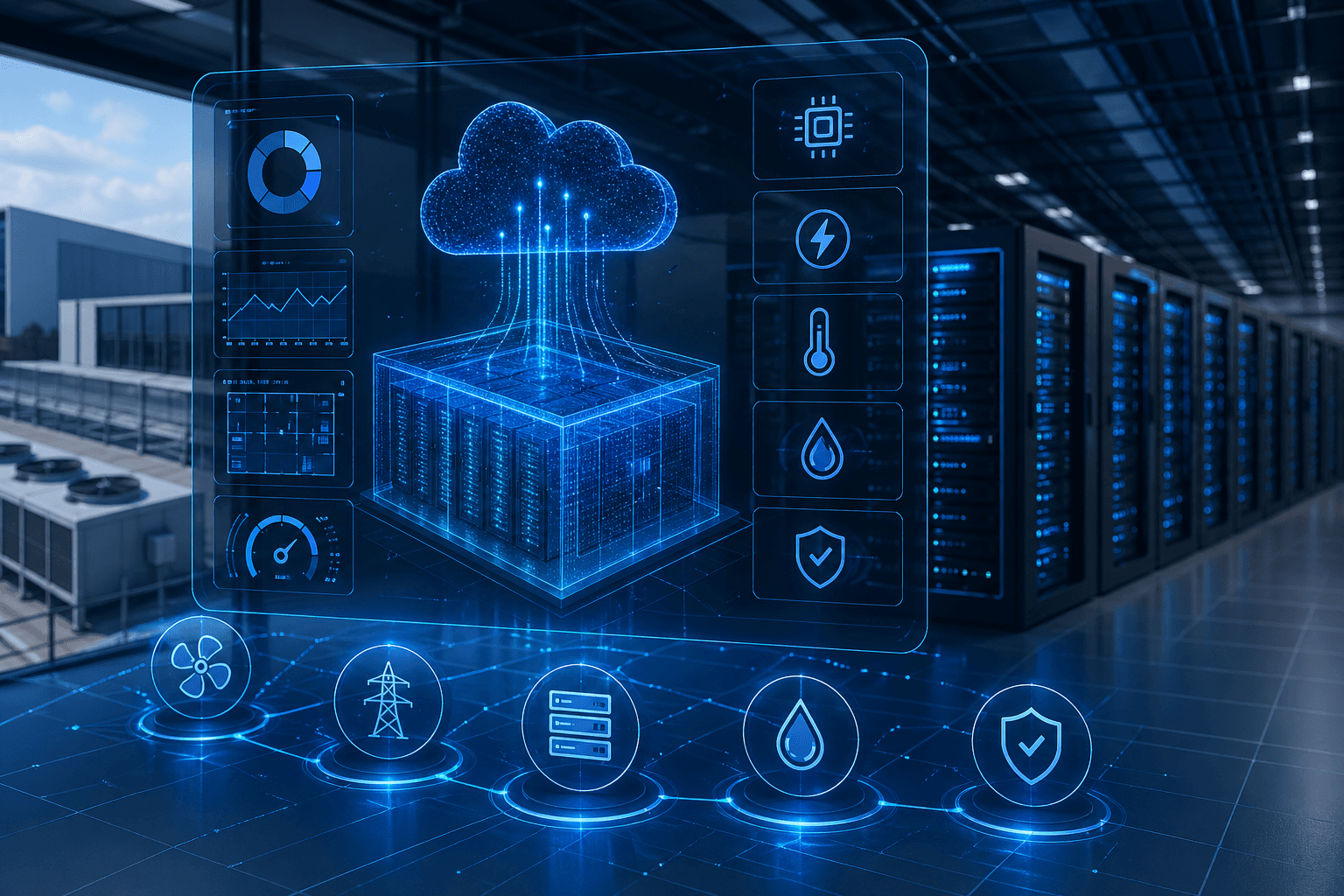
The enhanced KSManage platform introduces four integrated capabilities. First, full correlated visibility with real-time troubleshooting and 3D visualisation: the platform continuously collects real-time core metrics — GPU and CPU utilisation, video memory usage, power consumption, network bandwidth, and storage health — while aggregating operational events and network logs. Using automated topology discovery, KSManage tracks end-to-end cross-node workloads and builds an integrated measurement–log–trace data foundation. By correlating device health with port-level telemetry throughout the entire job lifecycle, it dynamically visualises resource allocation through real-time 3D modelling — transforming root-cause diagnosis from time-consuming investigation into rapid, accurate fault localisation and improving troubleshooting efficiency by up to 90%. Second, predictive hardware trend analysis with early warning: applying advanced algorithms to hardware telemetry, KSManage deeply analyses performance trends of critical components — including GPUs and storage devices — and can predict hardware failure risks up to seven days in advance, enabling proactive intervention before failures occur. Third, end-to-end application dependency correlation: KSManage delivers full correlated visibility across hardware, platforms, and workloads — enabling operators to understand how hardware anomalies affect live AI training tasks and correlate network events with business workflow disruption. Fourth, intelligent O&M incident management: automated fault detection, alarm management, and intelligent remediation reduce mean time to resolution and enable proactive rather than reactive operations.
KAYTUS's End-to-End AI Data Centre Strategy — Hardware, Liquid Cooling, and Intelligent Management
KAYTUS's KSManage upgrade is part of a broader end-to-end AI data centre strategy that combines hardware — AI servers supporting heterogeneous CPU, GPU, and DPU architectures — with advanced liquid cooling solutions designed for the power densities that next-generation AI workloads demand, and intelligent management software in KSManage. The strategic advantage of this combined approach is that KSManage has deep integration with KAYTUS's own hardware — enabling firmware-level telemetry, out-of-band management, and AIOps capabilities that externally-built management software cannot replicate. KSManage V2.0 (released April 2025) demonstrated this: by automating management of over 3,000 servers, it reduced firmware upgrade time by 70%, increased configuration accuracy to 99.8%, and enabled daily deployment of up to 500 servers — delivering an 80% boost in overall O&M efficiency and a 40% reduction in hardware failure rates. The current upgrade specifically targets the AI-era data centre — where the rapid evolution of large language models is driving widespread adoption of heterogeneous architectures and increasing the need for cross-regional collaboration, raising O&M complexity to levels that traditional monitoring tools were never designed to handle.
Key Takeaways
- • KAYTUS (Singapore; leading provider of end-to-end AI server and liquid cooling solutions; cloud/AI/edge computing/emerging applications) has significantly upgraded KSManage — announced 21 April 2026. Introduces full-stack, four-level visibility across components, servers and cabinets, clusters, and AI jobs. Addresses four critical O&M challenges: complex troubleshooting, higher component failure rates, intricate AI application dependencies, delayed O&M incident response. A single AI data centre outage can result in losses exceeding USD $1 million.
- • Four-layer intelligent monitoring framework — capability 1: Full correlated visibility + real-time troubleshooting + 3D visualisation. Continuously collects: GPU/CPU utilisation, video memory usage, power consumption, network bandwidth, storage health, operational events, network logs. Automated topology discovery tracks end-to-end cross-node workloads. Integrated measurement–log–trace data foundation. Correlates device health with port-level telemetry throughout entire job lifecycle. Dynamically visualises resource allocation through real-time 3D modelling. Troubleshooting efficiency improved by up to 90% — transforms root-cause diagnosis from days to rapid automated localisation.
- • Four-layer framework — capabilities 2, 3, and 4: (2) Predictive hardware trend analysis: advanced algorithms applied to hardware telemetry; performance trends of critical components (GPUs and storage) deeply analysed; hardware failure risks predicted up to seven days in advance; proactive mitigation under sustained high-load conditions; component failure rates reduced at source. (3) End-to-end application dependency correlation: full correlated visibility across hardware, platforms, and workloads; correlates hardware anomalies with live AI training tasks; correlates network events with business workflow disruption. (4) Intelligent O&M incident management: automated fault detection, alarm management, and intelligent remediation; mean time to resolution reduced; proactive operations replacing reactive firefighting.
- • KSManage V2.0 (April 2025) proven performance: automated management of 3,000+ servers; firmware upgrade time reduced by 70%; configuration accuracy 99.8%; daily deployment of up to 500 servers; 80% boost in overall O&M efficiency; 40% reduction in hardware failure rates. Fault diagnosis accuracy rate: over 98%. Energy consumption reduction: 20%. Compatibility: 5,000+ mainstream IT device models. The current full-stack O&M visibility upgrade builds on this foundation — extending from general data centre management to AI-specific four-level visibility designed specifically for heterogeneous AI infrastructure.
- • Strategic significance: KAYTUS's end-to-end approach — combining AI servers, liquid cooling, and intelligent management software in KSManage — positions it as an integrated AI data centre partner rather than a point solution provider. The market context driving this upgrade is the LLM era: the rapid evolution of large language models is accelerating the development of AI data centres, driving adoption of heterogeneous CPU/GPU/DPU architectures and increasing the need for cross-regional collaboration — raising O&M complexity to levels that traditional IT monitoring tools (built for homogeneous compute environments) were never designed to handle. KSManage's seven-day hardware failure prediction and 90% troubleshooting efficiency improvement directly address the business risk: at over $1M per outage, proactive O&M is not an operational nicety but a financial imperative for any organisation running mission-critical AI infrastructure.