
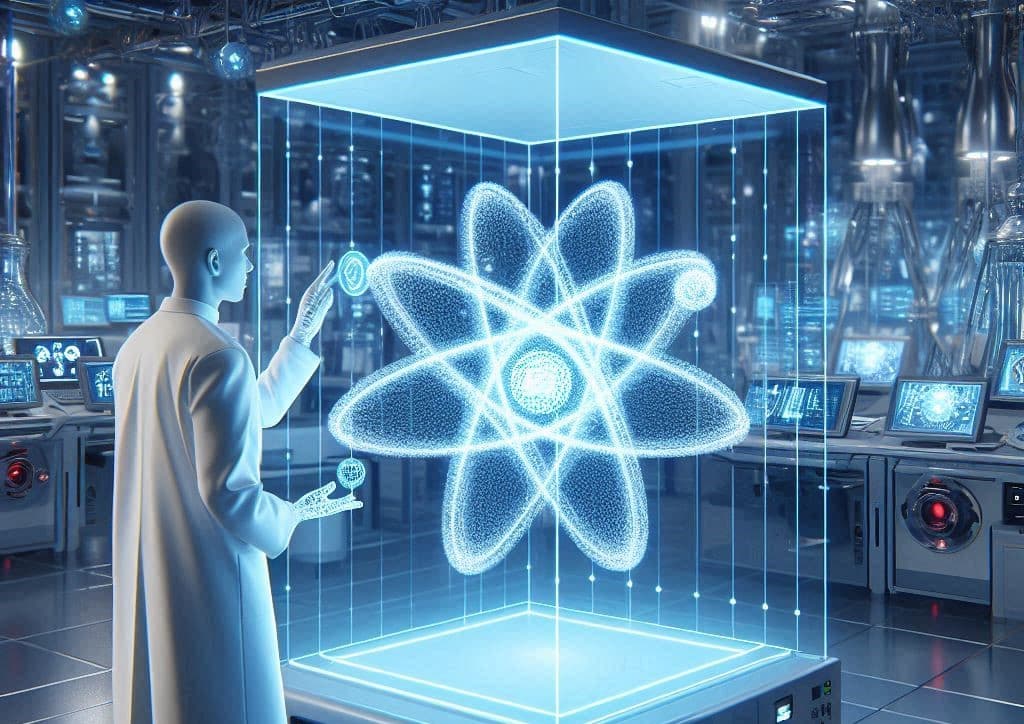
New Strides in Microsoft Azure Quantum Computing
Microsoft and Atom Computing are partnering to push the boundaries of quantum computing. By leveraging the principles of quantum mechanics—such as superposition and entanglement—this collaboration aims to build more reliable and scalable quantum systems.
This partnership has the potential to accelerate scientific research and expand quantum technology applications across various industries. Let’s explore the latest advancements and their impact on the future of computing.
The Microsoft and Atom Computing Collaboration
At the core of this partnership is the integration of Atom Computing’s advanced neutral-atom qubits with Microsoft’s qubit-virtualisation system. Neutral-atom qubits use atoms with no net electrical charge, manipulated with precise pulses of light, to store and process quantum information. This method allows for tightly packed qubits while maintaining high connectivity, a crucial factor in scaling quantum systems.
Microsoft’s qubit-virtualisation system transforms physical qubits into logical qubits by detecting and correcting errors during quantum computations. Together, these innovations lay the groundwork for more reliable and powerful quantum computing solutions.
Hybrid Quantum Applications: What Makes It Work?
Quantum computing is designed to tackle complex problems beyond the reach of classical computers. However, physical qubits are highly error-prone, making quantum error correction essential.
Microsoft’s qubit-virtualisation system integrates advanced error correction techniques, transforming Atom Computing’s neutral-atom qubits into logical qubits with significantly reduced error rates. These logical qubits enhance the reliability of quantum operations, making large-scale quantum computations feasible.
Neutral Atoms: A Game-Changer for Quantum Computing
Neutral atoms offer a unique advantage over other qubit technologies: they can be densely packed and manipulated using lasers. Atom Computing utilizes this capability to create large arrays of neutral atoms, each acting as a physical qubit, enabling entanglement and quantum operations.
Scalability is crucial for building practical quantum computers, and neutral atoms excel in this regard. Additionally, they are less susceptible to noise compared to other qubit technologies, making them highly suitable for quantum error correction.
Atom Computing has achieved an impressive 99.6% two-qubit gate fidelity—one of the highest in the industry—allowing for effective quantum error correction and logical qubit formation.
Jointly Generating Logical Qubits
Microsoft and Atom Computing have achieved a significant milestone by generating and entangling 24 logical qubits. These qubits, derived from neutral-atom qubits, were entangled into a Greenberger-Horne-Zeilinger (GHZ) state, marking the highest number of entangled logical qubits recorded to date.
This collaboration has demonstrated success in reducing error rates and improving qubit stability. The logical qubits created from neutral atoms exhibited significantly lower error rates than their physical counterparts, showcasing the effectiveness of Microsoft’s qubit-virtualisation system in managing and correcting errors.
A Reliable Quantum Machine for the Future
Looking ahead, Microsoft and Atom Computing are unveiling a powerful new quantum machine, integrated with Microsoft Azure Quantum. This system will combine quantum computing with cloud-based high-performance computing (HPC) and artificial intelligence to accelerate scientific research in fields like chemistry, materials science, and beyond.
Key components of this offering include Azure Elements, a platform that integrates AI and cloud HPC for advanced computational research. Tools like Generative Chemistry and Accelerated Density Functional Theory (DFT) will enable faster scientific discoveries and broader quantum applications.
Commercialising Quantum for Broader Impact
Beyond research, this quantum machine has significant commercial potential. Microsoft and Atom Computing plan to offer their quantum technology for purchase, with deliveries anticipated in 2025—a crucial step toward making practical quantum computing a reality.
The partnership also fosters quantum education and workforce development. As the demand for quantum professionals rises, initiatives by Microsoft and Atom Computing will help equip the next generation with the skills needed to drive future quantum advancements.
Conclusion
This collaboration marks a major step toward achieving scientific quantum advantage—the point where quantum computers consistently outperform classical computers in real-world applications.
With innovations in neutral-atom qubits, quantum error correction, and AI-driven quantum research, Microsoft and Atom Computing are paving the way for next-generation quantum technologies that will revolutionize industries worldwide.
As quantum computing evolves, partnerships like this illustrate that the future of computing isn't just about speed—it’s about redefining how we solve the world’s most complex challenges.