
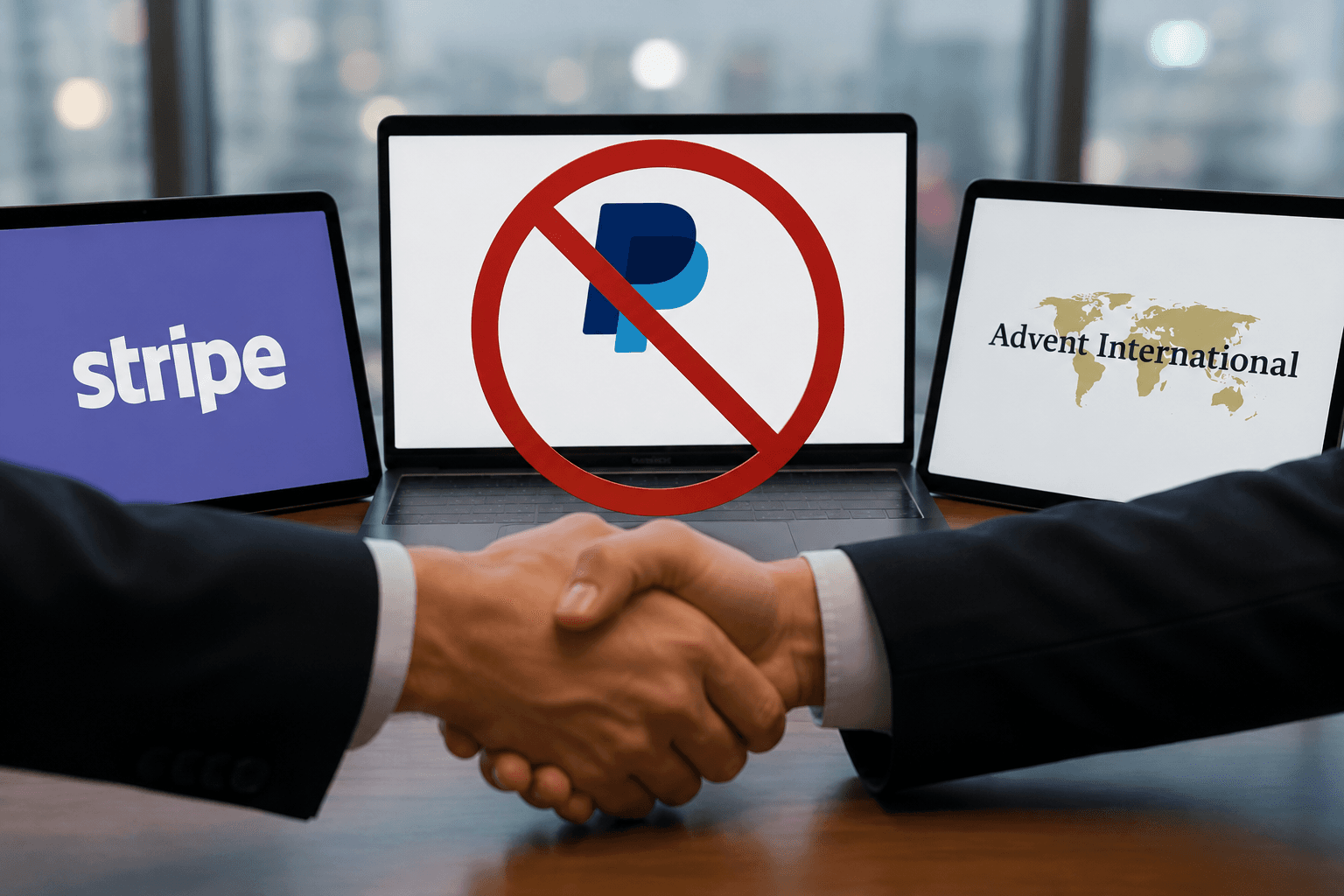
The Biggest Fintech Deal That Never Happened
Stripe and Advent walk away from a US$53.4bn bid for PayPal — and Stripe's real ambitions move somewhere else entirely.
The Brief
Stripe and private-equity firm Advent have abandoned their US$53.4bn bid for PayPal, shelving what would have been the largest fintech takeover ever recorded. PayPal's own operational turnaround lifted its shares far beyond the offer, closing the window on a cheap buy. Meanwhile, Stripe redirected its capital toward AI infrastructure, snapping up model marketplace OpenRouter for more than US$7bn — a sign of where it now believes the value lies.
A record-breaking acquisition has quietly collapsed. The joint effort by Stripe and Advent to buy PayPal, first floated in mid-July 2026, is now confirmed to be off, ending months of speculation about a deal that would have reshaped the payments landscape.
Had it closed, the transaction would have set a new high-water mark for the sector — and flipped the usual order of things, with a privately funded challenger absorbing a publicly listed heavyweight. Instead, shifting fortunes on both sides pulled the deal apart.
A bid that arrived at the wrong moment
The consortium's offer valued PayPal at just over US$53bn, or US$60.50 a share — a number that looked far more compelling when it was first drawn up than when it was withdrawn.
At the time the approach took shape, PayPal's stock was languishing near a 52-week floor, having sunk to around US$38.46 per share. On paper, that made the company an attractive target for a well-capitalised buyer willing to bet on a rebound. The unusual structure — a venture-backed player moving on an S&P 500 constituent — underscored just how far PayPal's valuation had slipped. When approached for comment, Advent declined to respond.
PayPal priced itself out of a takeover
The single biggest reason the deal fell apart may be PayPal's own recovery, which erased the discount the buyers were counting on.
Under chief executive and president Enrique Lores, the company pushed through a restructuring aimed at tightening its operations. Lores framed the effort as a return to basics — getting nearer to consumers, organising the business around three core units, streamlining internal ways of working, and putting a firmer emphasis on accountability and execution. He argued that matching the company's structure to its strategy would set it up for steadier, more durable growth.
The overhaul included a wave of senior leadership changes and the rebranding of Zettle into PayPal Point of Sale. The results showed up in the share price, which climbed to US$79.22 — comfortably above the US$60.50 the consortium had been willing to pay, and effectively pricing the bid out of contention.
To accelerate growth and unlock our full potential, we need to recommit to our fundamentals. — Enrique Lores, President and CEO of PayPal
Stripe's attention shifts to the AI economy
Even as the PayPal talks played out, Stripe was quietly placing a very different bet — one focused on the plumbing of artificial intelligence rather than consumer wallets.
During the negotiation period, Stripe completed a stock-based acquisition of OpenRouter, an AI model marketplace, in a deal worth more than US$7bn. That followed a US$1.3bn valuation for OpenRouter earlier in May 2026, a sharp mark-up in a matter of months.
Stripe chief executive Patrick Collison described OpenRouter as a standout developer tool and the leading marketplace for routing across AI models and inference providers. He argued that companies will increasingly need to manage flows of AI tokens alongside flows of revenue, positioning OpenRouter as the layer that helps them allocate what he called the new currency of intelligence.
Read together, the two moves tell a clear story. By stepping back from a legacy payments giant and doubling down on the infrastructure that meters and monetises AI, Stripe appears to be staking its future on owning the rails of the AI economy rather than fighting over established digital wallets.
Key takeaways
- The record deal is dead. Stripe and Advent's US$53.4bn bid for PayPal, which would have been the largest fintech acquisition ever, is now off the table.
- Timing undid the offer. The bid was drafted when PayPal shares sat near a 52-week low around US$38.46, making the discount central to the buyers' case.
- PayPal's turnaround changed the maths. An operational overhaul under Enrique Lores lifted the stock to US$79.22, well past the US$60.50 offer price.
- Stripe pivoted to AI. It acquired model marketplace OpenRouter for more than US$7bn, betting on token flows over consumer payments.
- Strategy over scale. Stripe now looks focused on owning the infrastructure that routes and monetises AI rather than acquiring incumbent wallets.