
How Coupa and Rossum Are Rewriting the Rules of Spend Management with AI
A landmark acquisition and a real-world blueprint show why eliminating fragmentation — not just digitising it — is the defining challenge for finance leaders today.
The Brief
As enterprise technology stacks grow more complex, finance and procurement teams are drowning in disconnected systems, manual workflows and invisible spend. Coupa's planned acquisition of AI document-intelligence firm Rossum — announced at Coupa Inspire 2026 — points toward a new era of autonomous spend control. The partnership's work with Eurowag, delivered alongside Accenture, already demonstrates what a unified, AI-first accounts payable model can achieve in practice: a 70% automation rate, processing times cut from nine days to four, and on-time payments exceeding 90%.
Finance operations are at an inflection point. Across industries, the tools meant to simplify procurement and accounts payable have proliferated to the point where they create the very fragmentation they were meant to solve.
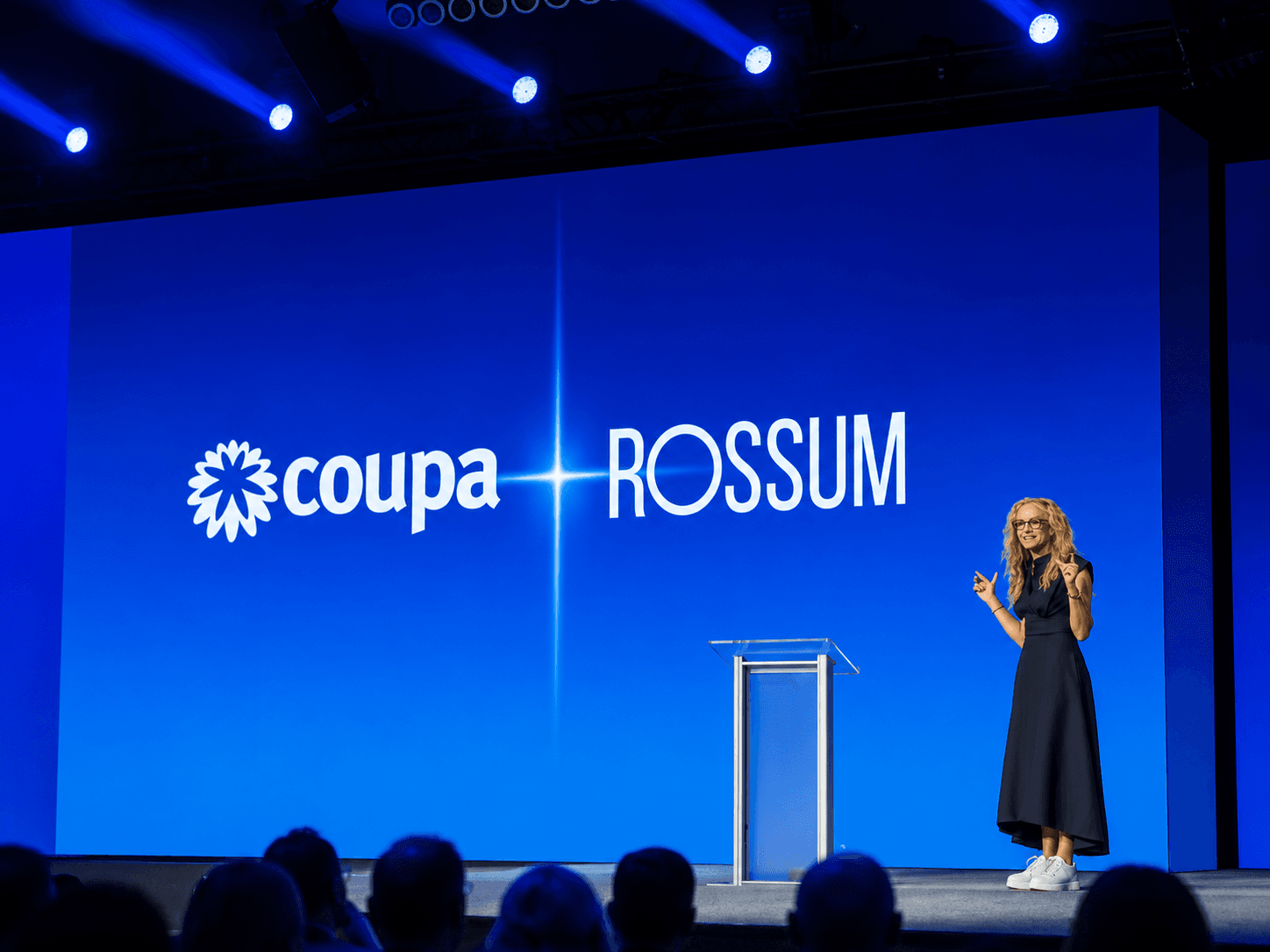
When Coupa CEO Leagh Turner took the stage at Coupa Inspire 2026 in Las Vegas to announce the planned acquisition of Rossum, it was more than a corporate milestone — it was a statement about where intelligent spend management is heading. Together, the two companies are laying out a vision for what fully autonomous, AI-driven finance operations could look like at global scale.
The fragmentation problem finance can't ignore
As organisations scale, finance, procurement and IT functions tend to accumulate tools rather than replace them. The result is a patchwork of specialised platforms that rarely communicate effectively with one another — a condition widely referred to as "tool sprawl".
The consequences are predictable: spend becomes difficult to track, duplicate subscriptions go undetected, reconciliation consumes hours that could be directed elsewhere, and shadow spend emerges in the gaps. For leaders trying to improve agility and control, the challenge is no longer simply moving from paper to digital — it is knitting fragmented systems, teams and data into a single coherent operating model that can surface the right information at the right moment.
A partnership built on proven results, now becoming an acquisition
Coupa and Rossum have worked in partnership since 2024, integrating Rossum's intelligent document processing capabilities into Coupa's broader spend management platform. That collaboration already streamlines complex accounts payable invoicing for shared customers. The acquisition, announced at this year's Coupa Inspire, takes the relationship further — extending Rossum's AI-first technology across the full source-to-pay function rather than limiting it to invoice processing alone.
At the heart of Rossum's offering is a purpose-built Transactional Large Language Model (T-LLM) trained on tens of millions of financial documents. Unlike legacy optical character recognition systems, this model applies what Rossum describes as transactional intelligence — an understanding of how financial data actually behaves in context — and continuously adapts as it encounters new inputs. The practical effect is faster processing, fewer errors and a system that improves with use rather than degrading over time.
What Eurowag's transformation actually looked like
For a concrete illustration of what a unified Coupa-Rossum deployment can deliver, the Eurowag case study is instructive. The London-headquartered commercial mobility and financial services provider had grown rapidly through acquisitions, and that growth left behind a patchwork of manual workflows and siloed operations that made group-wide visibility over spend nearly impossible.
Working alongside Accenture, the team standardised Eurowag's procure-to-pay processes on Coupa, replacing disconnected invoice workflows with automated accounts payable solutions and rolling out Contract Lifecycle Management across its 2,000-person workforce. Automated three-way matching — linking purchase orders, receipts and invoices — replaced manual checking, tightening financial controls and reducing exposure to both fraud and overpayments. The outcome: an on-time payment rate that rose by 30 percentage points, processing times that roughly halved, and a group-wide audit trail that now satisfies compliance requirements across all entities.
Marcella Mathes, Head of Finance Processes and Digital Finance at Eurowag, noted that the platform now provides a clear, traceable connection between purchase orders, receipts and invoices — giving both finance and compliance teams a dependable single source of truth.
With Rossum, we believe we can help customers save the next US$300bn in five years — with a system of decision and intelligence that is unrivalled. — Leagh Turner, CEO, Coupa
What the upcoming webinar will cover
For finance, procurement and IT leaders who want to move from concept to execution, Coupa and Rossum are hosting a live webinar on 17 June — The Global Accounts Payable Blueprint: Eliminating Fragmentation for Real-Time Visibility — running from 10:00am to 11:00am BST.
The session will walk through how Eurowag shifted from reactive, manual firefighting to proactive, real-time spend oversight; how Accenture designed a core operating model capable of scaling across 60 global entities; and what Eurowag's 2026 roadmap looks like as it applies advanced AI strategies and consolidates global supplier contracting. Speakers include Petr Podávka, Eurowag's Accounts Payable Manager; Alexander Boehme, Manager of Solutions Advisory at Coupa; Sam Overton, Regional Vice President at Rossum; and Jarda Privoznik, Technology Delivery Associate Director at Accenture, who has led Eurowag's digital transformation programme since 2021.
Why agentic AI is the next frontier in spend management
The Coupa-Rossum combination points toward something more ambitious than process improvement: a model in which AI doesn't simply automate existing tasks but actively makes decisions within the spend management workflow. Where traditional AP automation flags exceptions for humans to review, an agentic model can resolve a much larger share of them autonomously — routing invoices, matching documents, flagging anomalies and releasing payments without manual intervention at each step.
For organisations managing hundreds of thousands of transactions across multiple geographies and currencies, the compounding effect of those incremental decisions is material. Marginal gains in processing speed, approval accuracy and fraud detection translate directly into working capital efficiency, supplier relationship quality and audit readiness — outcomes that matter to the CFO, the procurement function and the board simultaneously. The Eurowag results — a 70% automation rate and processing times reduced from nine days to four — offer a measurable preview of what that looks like in practice at enterprise scale.
Key takeaways
- Tool sprawl is the root cause, not a symptom. Fragmented platforms produce invisible spend, duplicate costs and reconciliation burdens that undermine the very efficiency gains technology was meant to deliver.
- AI-first document intelligence is a step change from legacy OCR. Rossum's T-LLM adapts to unique financial data inputs in real time, enabling accuracy and speed that rules-based systems cannot match.
- Unified platforms unlock outcomes that point solutions cannot. Eurowag's 70% automation rate and near-halved processing times were only achievable because accounts payable, contract management and procurement operated from a single data foundation.
- Acquisitions that deepen existing partnerships reduce integration risk. Coupa and Rossum's move from collaboration to acquisition builds on two years of proven joint deployment — giving customers a more predictable path to value.
- Agentic AI will redefine what autonomous spend management means. The shift from AI-assisted decisions to AI-executed decisions at the transaction level is already underway, and the organisations that design for it now will compound the advantage over time.