
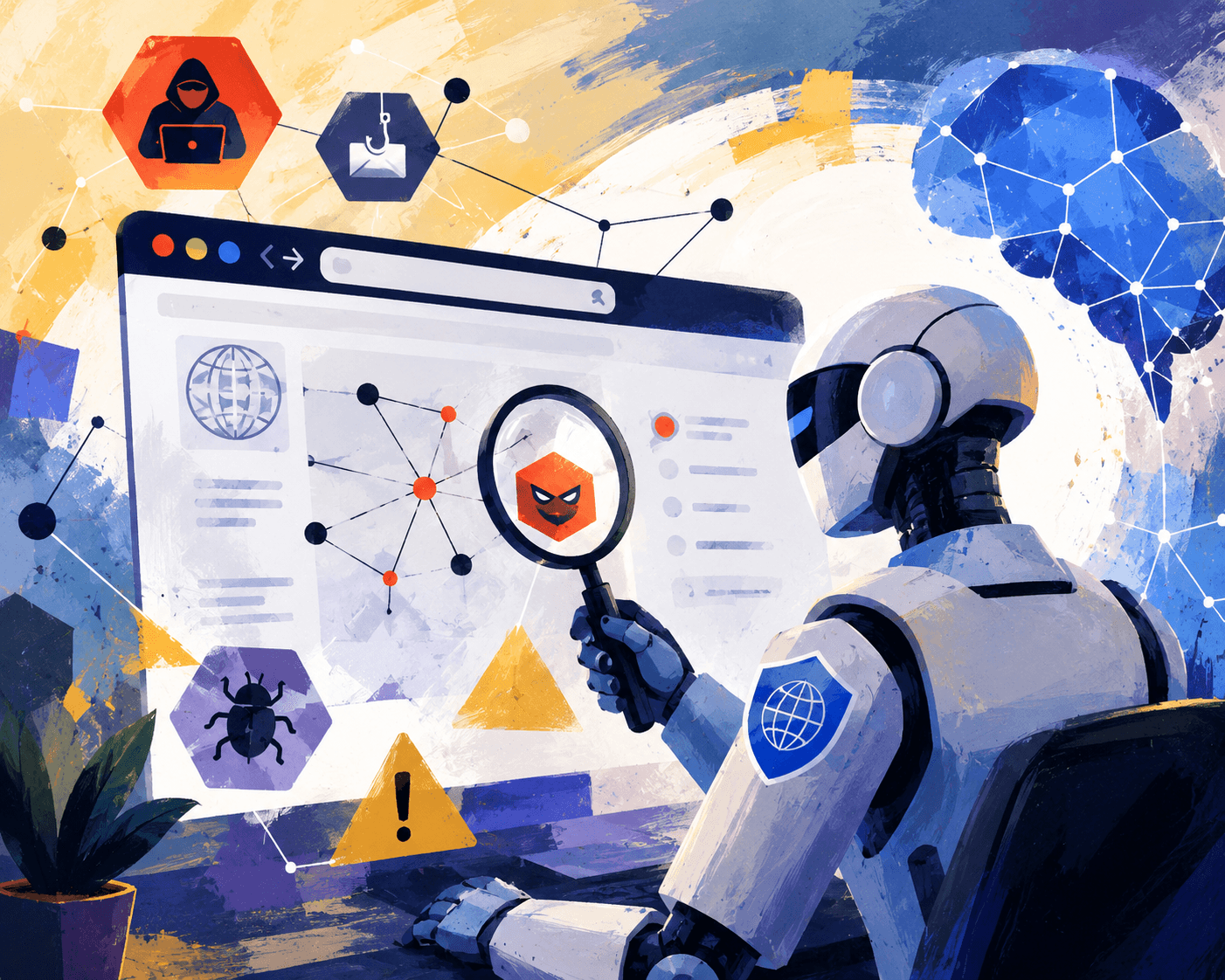
Push Security Launches AI-Native Agentic Threat Hunting for the Browser — Redefining Detection and Response in the Secure Enterprise Browser Market
The browser has become the primary interface through which enterprise employees do their work — and, correspondingly, the primary surface through which adversaries launch identity attacks, steal credentials, hijack sessions, and compromise accounts. The security tooling built to protect that surface has not kept pace. Traditional detection methods based on indicators of compromise — domains, URLs, IP addresses — are rapidly losing effectiveness as AI-powered attackers automate campaign mutation at a speed that renders signature-based approaches structurally inadequate. Push Security, the most powerful AI-native security tool in the browser, has announced a major evolution of its platform — introducing AI-native, agentic threat hunting and detection engineering within its Secure Enterprise Browser extension.
The new capabilities combine deep threat research, rich browser telemetry, and AI agents to deliver what Push positions as the most powerful detection capability in the industry — shifting the detection model from brittle IOC-matching to durable identification of attacker Techniques, Tactics, and Procedures (TTPs), which are significantly harder for adversaries to evade. The capabilities are available now to Push customers and represent a new category standard for AI-driven browser security — one that prioritises real detection outcomes over abstract AI claims.
"When we started Push, identity attacks in the browser were the primary source of attacks, and they still are. What's changed is that AI has given attackers the ability to operate at a speed and scale that traditional security tools cannot match. As the browser becomes the central interface for work and a primary attack surface, Push's agentic approach ensures security teams can keep pace with increasingly sophisticated AI-enabled threats."
— Adam Bateman, CEO, Push Security
Why IOC-Based Detection Is Failing — The Shift to TTP-Focused Defence
Indicators of compromise — domains, URLs, IP addresses — have been the foundation of email and browser security detection for over a decade. The problem with IOC-based detection is that it is trivially evasable: attackers simply rotate infrastructure. Register a new domain, move to a new IP range, modify the URL pattern — and the detection misses them entirely. This was a manageable limitation when attack campaigns required manual effort to rebuild. It becomes a structural failure point when AI can regenerate and redeploy attack infrastructure at machine speed.
Techniques, Tactics, and Procedures are fundamentally harder to evade because they describe how an attack operates — the sequence of actions, the manipulation patterns, the behavioural signatures of malicious intent — rather than the specific infrastructure it runs on. An adversary can change their domain in seconds. They cannot easily change their attack technique without rebuilding their entire operation. Push Security's shift to TTP-focused detection is the architectural response to an attacker landscape where AI-driven infrastructure rotation has made IOC-based defences increasingly unreliable.
The differentiation Push brings is not in the AI model it uses — Push explicitly treats frontier AI models as interchangeable infrastructure — but in the context those models are given. Years of deep browser threat research, continuously evolving TTP knowledge bases, and trillions of browser events provide the hunting ground and signal quality that determine what the agents can find. Context is the moat, not the model.
The Dual Loop Architecture — Inner Loop Precision, Outer Loop Discovery
Push's agentic system operates through two continuous and complementary loops — each addressing a different dimension of the browser threat problem and together providing coverage that no static detection system can match.
Inner Loop — Real-Time Detection and Response for Known Attacker TTPs
The inner loop handles 98% of detections — delivering real-time detection and response for known attacker techniques through prebuilt, configurable controls that block established TTPs at the moment of browser activity. This layer operates with analyst-level fidelity at machine speed, ensuring that the vast majority of known browser attack patterns — phishing kits, token theft, session hijacking, ClickFix social engineering, credential harvesting — are caught and blocked before the user experiences any consequence. Controls are configurable to the organisation's specific risk profile and deployment context.
Outer Loop — Continuous Discovery of New Threats Before They Reach Customers
The outer loop addresses the remaining and most important 2%: the emerging, previously unseen attack techniques that no existing rule set covers. AI agents continuously ingest new research and threat intelligence, generate and test hypotheses against browser telemetry, analyse emerging behaviours, reduce false positives, and develop new production-ready detections — shipping them into the inner loop before the techniques being studied have had time to impact Push's customers at scale. This continuous discovery cycle is what Push's research team describes as the key architectural advance: threat hunting expertise delivered as a product rather than a staffing requirement.
The Detection Pipeline — From Suspicious Activity to Production-Ready Detection
AI agents powered by frontier models are given deep contextual grounding — Push's internal TTP knowledge base, detection libraries, historical browser telemetry, and human-led research — to analyse suspicious activity, identify new attack techniques, and turn them into production-ready detections. When a hunt looks promising, agents deploy the full suite of analyst tools: analysing files, scripts, images, and domain intelligence to rapidly evaluate threats and return a verdict. This pipeline turns what was previously expert-only threat hunting into a continuously running automated system accessible to organisations of all sizes.
"AI is only as good as the context it has. We have spent years watching browser attacks evolve, hunting for new techniques before they're seen in the wild, and have built a platform that can scale that expertise across millions of browsers and billions of events per day. We are not just processing more data — we are isolating signals that really matter and finding new kits and techniques before they impact our customers."
— Jacques Louw, Chief Research Officer, Push Security
Threat Hunting Expertise Delivered as a Product — Democratising Enterprise-Grade Browser Security
One of the most significant commercial implications of Push's agentic approach is its democratisation of capabilities that were previously available only to organisations with large, specialised threat hunting teams. Advanced browser threat protection — hunting for new phishing kit variants, identifying session hijacking TTPs before they proliferate, detecting novel ClickFix and ConsentFix attack patterns — has historically required the kind of deep, full-time specialisation that most organisations cannot afford to staff.
By encoding that expertise into a continuously running agentic system, Push delivers enterprise-grade threat hunting as a single, easy-to-deploy solution — accessible to organisations from startups to global enterprises without requiring specialised in-house expertise. The browser extension deploys in minutes, works across every browser in the organisation without migration, and provides the security context that EDR and SIEM logs have historically been unable to deliver: in-browser visibility into phishing attempts, credential misuse, token theft, and shadow AI activity at the point where they actually occur.
Real-time detection and blocking of phishing kits, cloned login pages, ClickFix social engineering, and ConsentFix OAuth attacks — at the point of browser interaction, before credentials are submitted or tokens are stolen.
Token theft and session hijacking detection with full session timeline reconstruction — revealing attacker behaviour, blast radius, and OAuth exposure for rapid investigation and response after a compromise attempt.
Full visibility into AI tool usage in the browser — what is typed, pasted, uploaded, and authorised inside AI applications — giving security teams the context to govern data exposure through shadow AI, agent extensions, and unauthorised AI tool adoption.
Key Takeaways
Push Security has launched AI-native, agentic threat hunting and detection engineering within its Secure Enterprise Browser extension — shifting the detection model from brittle IOC-matching to durable TTP-based identification of attacker behaviour, available now to Push customers.
The dual loop architecture delivers 98% of detections through a real-time inner loop blocking known TTPs at machine speed with analyst-level fidelity, while a continuous outer loop hunts for emerging, previously unseen attack techniques — turning new discoveries into production-ready detections before they reach customers at scale.
Push's differentiation is not in the AI model it uses — frontier models are treated as interchangeable infrastructure — but in the depth of context those models receive: years of browser threat research, a continuously evolving TTP knowledge base, and trillions of browser events daily, providing a hunting ground that determines what agents can find.
By encoding expert threat hunting into a continuously running agentic system, Push democratises enterprise-grade browser security for organisations of all sizes — deploying in minutes across every existing browser without migration, covering phishing, token theft, session hijacking, identity hardening, and shadow AI visibility from a single extension. Learn more at pushsecurity.com.
The launch of agentic threat hunting at Push Security reflects a broader truth about where browser security must go. As Jacques Louw noted: browser security does not need more dashboards or marketing around undefined AI risks — it needs systems that can keep up with how AI is actually used in attacks in the real world. That means security that continuously learns, adapts, and ships real detections at the pace of the threat, not one that lags days or weeks behind it. For an enterprise landscape where the browser is the primary working environment and identity attacks remain the leading cause of breach, the ability to detect and respond at the speed and scale of AI-powered adversaries is not a competitive differentiator — it is the baseline requirement.
To learn more about Push Security's agentic threat hunting capabilities and the Secure Enterprise Browser extension, visit pushsecurity.com.