
Visa and Airwallex Set Out to Rewire Freight Payments
A card network and a cross-border fintech are wiring finance straight into shipping platforms — chasing faster settlement, cleaner currency handling and cash that stops sitting idle in transit.
The Brief
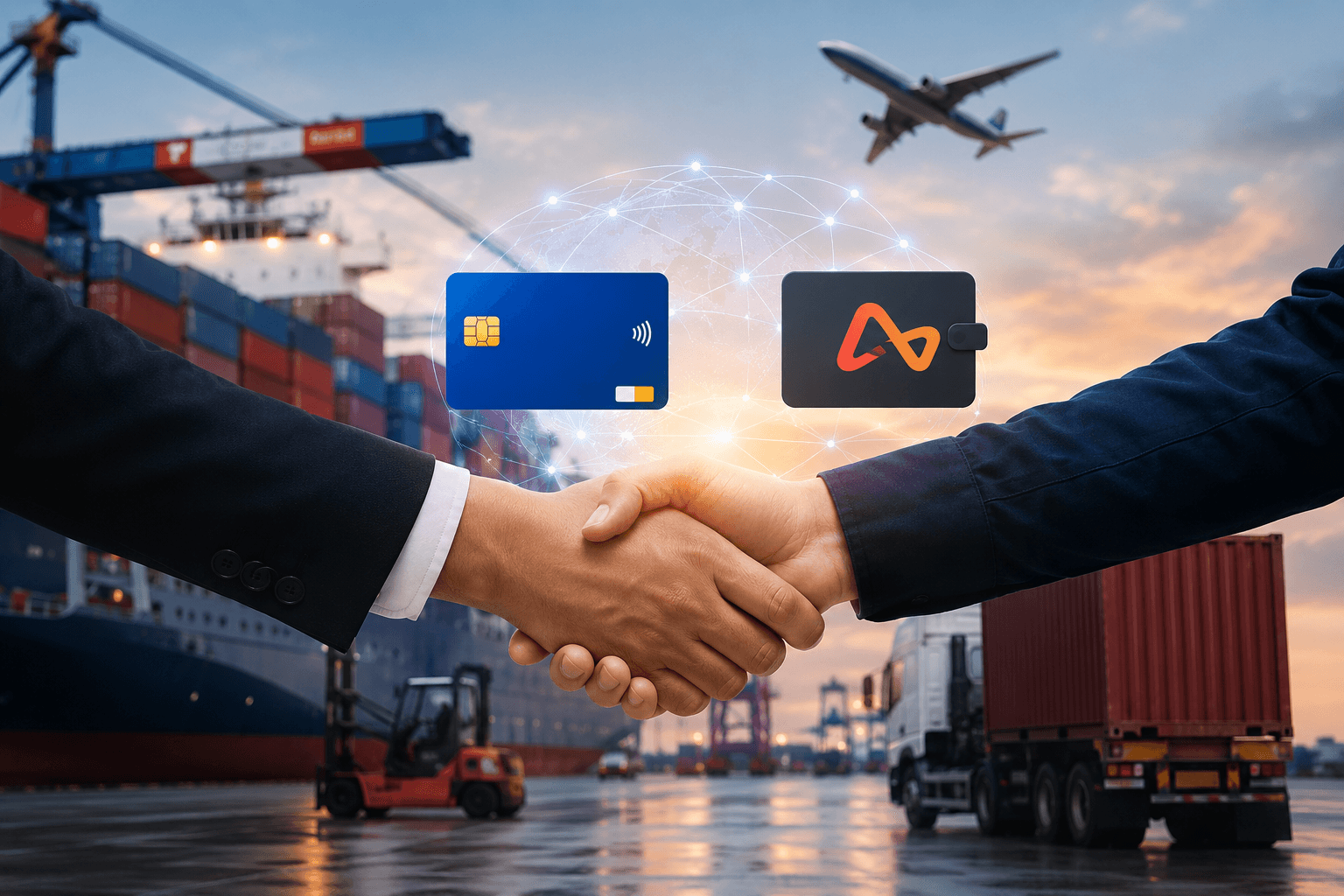
Visa and Airwallex are teaming up to build embedded-finance tools for freight and shipping platforms, one of the least modernised corners of global commerce. Visa supplies commercial-payments know-how, acceptance strategy and risk design; Airwallex brings multi-currency rails and platform technology. The goal is to fold payments, working capital and cross-border money movement into the software logistics firms already run — turning payment into a native feature rather than a slow, disconnected afterthought.
Freight keeps the world's goods moving, yet the money behind those shipments still crawls. While logistics software has raced ahead, the payment systems underneath it remain fragmented, manual and slow — a mismatch Visa and Airwallex now want to close.
The two companies have agreed to develop embedded-finance solutions aimed squarely at freight and shipping platforms, betting that one of the most operationally tangled industries in commerce is ready for a payments overhaul built around how it actually works.
Two heavyweights, one messy industry
The partnership splits along each firm's strengths: Visa handles the commercial-payments layer while Airwallex supplies the cross-border plumbing.
On Visa's side, the contribution is expertise in commercial payments, acceptance strategy, risk management and solution design. Airwallex brings its embedded-finance toolkit, multi-currency infrastructure and global platform technology. Rather than dropping a generic payments product into logistics, the pair say they intend to shape solutions around the operational realities of freight — the kind of specialised, market-specific work a one-size-fits-all model tends to miss.
Alessandro Figueroa, who leads new verticals and partnerships for Visa's commercial solutions in Europe, frames freight as economically essential but stuck with payment processes that are broken up, manual and inefficient. As digital freight platforms scale, he argues, they need financial tools that slot into existing workflows without piling on complexity — and combining Visa's payments depth with Airwallex's technology is meant to bring those tools to market quickly.
Why freight's money moves too slowly
Digitisation has swept through logistics operations, but the financial systems supporting the sector have lagged well behind.
Freight businesses still wrestle with disjointed payment flows, drawn-out settlement cycles and the manual grind of document handling — each of which slows cash movement and drives up cost. The drag is especially steep in shipping, where a payment can take roughly 42 days on average to land with the invoicing company, and where processing and administrative overhead can swallow close to a fifth of total transportation costs.
Christos Chamberlain, Airwallex's general manager for the UK and Europe, casts the problem in blunt operational terms: money trapped while payments clear across borders is capital that should be funding the next shipment instead of stalling in transit. Reliability, he notes, is what freight reputations are built on — getting the container there on time, every time — and payments, in his view, should behave with the same precision.
Cash stuck clearing across borders is capital that should be paying for the next shipment, not idling in transit. — Airwallex, on freeing up working capital
Payments as a feature, not a bolt-on
The core idea is to embed financial capability directly inside freight products, so it stops being a separate step bolted on at the end.
In practice, that means logistics customers could manage costs, tap working capital when they need it and move money across borders from within the software they already use — payment becoming a built-in function of the freight platform rather than a disconnected process running alongside it. For the businesses on those platforms, the promise is smoother cash flow, less friction in cross-border trade and fewer manual handoffs.
Figueroa points to shifting expectations as the driver: as industries digitise, companies increasingly want financial services that fit naturally into the platforms and workflows already in place, rather than tools they have to bend their operations around.
A bet on vertical-specific finance
For both firms, freight is as much a strategic proving ground as a market opportunity.
The deal strengthens Visa's commercial-payments proposition in a vertical where embedded finance has obvious utility, and it signals a wider move toward designing around specific industries instead of leaning only on general-purpose payment tools. For Airwallex, the collaboration extends a platform strategy and deepens a relationship that already spans cross-border B2B payments — while giving it a chance to show its infrastructure can carry more specialised applications in complex B2B settings.
If it works, the payoff is a template: prove that embedded finance can be tuned to the quirks of one demanding industry, and the same playbook can be pointed at the next.
Key takeaways
- Freight is the target. Visa and Airwallex are aiming embedded finance at shipping and logistics, one of commerce's most operationally complex and least modernised verticals.
- Strengths are split cleanly. Visa supplies commercial-payments, risk and acceptance expertise; Airwallex brings multi-currency rails and platform technology.
- The pain is real and measurable. Shipping payments can take around 42 days to settle, and processing and admin can consume close to a fifth of transportation costs.
- Payment becomes native. The plan folds settlement, working capital and cross-border money movement into freight software rather than leaving them as separate steps.
- It's a vertical playbook. Both firms treat freight as proof that industry-specific embedded finance can scale to other complex B2B markets next.